Recursion
-
Recursion is a function/method that calls itself
-
A recursive function must have at least one base case (stopping condition) and one recursive case (where the function calls itself)
-
Each call is placed on the stack (LIFO - last in, first out)
|
|
|
Note
|
Technical explanation of stack vs. heap: https://www.guru99.com/java-stack-heap.html |
Common Issues In Recursion
-
Forgetting the base case causes an "infinite" loop, leading to a
StackOverflowError -
Deep recursion can be inefficient and cause performance issues
-
Tail recursion optimization (TCO) is not supported in Java
-
TCO is compiler feature that eliminates stack frames for certain recursive calls, allowing recursion to run without growing the stack
-
JVM always creates a new stack frame for every method call
-
JVM does not provide an instruction to replace a stack frame during a recursive call
-
Common Examples
-
Common examples include calculating sums or factorials
-
Sum Example: https://gist.github.com/MattToegel/97d98779bb7e065739f7b8dd3b43906c
-
Factorial Example: https://gist.github.com/MattToegel/1aeb8932a06599518166afe4bffc79c9
-
Consider using iteration instead of recursion for cases where stack memory is a concern
Performance Considerations
-
Code: https://gist.github.com/MattToegel/2b3ff670235e920eae6f17f9201d99ba
-
Demonstrates efficiency differences between recursion and iteration for summing numbers
-
Recursive approach is intuitive but can be slower for large inputs due to stack overhead
-
Iterative approach avoids stack overhead and is generally faster for larger computations
-
File Search Example:
-
Code: https://gist.github.com/MattToegel/de77e31b2e27cc6080fc2c231a4f4293
-
Example of searching for files matching a partial name with an optional extension
-
Edge Case: Ensure the program handles directories without proper read permissions to prevent crashes
Maze Solver Example:
-
Code: https://gist.github.com/MattToegel/ea4574377787b4b62415d4b455b0291c
-
Demonstrates recursion to find a path through a maze
-
Ensure the maze structure has exactly one start ('S') and one exit ('E') to avoid ambiguous results
Trees
-
Trees are non-linear, hierarchical data structures
-
Common types include binary trees, useful for searching, graphics, routing, and AI behaviors
-
File systems often follow a tree structure
Types of traversal:
-
Depth-First Search (DFS) - Depth-first search is a type of traversal that explores as deeply as possible into each branch before moving to the next sibling node.
-
In-Order - Visit the left subtree first, then the root node, and finally the right subtree
-
Pre-Order - Visit the root node first, then the left subtree, followed by the right subtree
-
Post-Order - Visit the left subtree first, then the right subtree, and finally the root node
-
-
Breadth-First Search (BFS) / Level Order - Visits all the nodes of a level before proceeding to the next level
-
Time Complexity: DFS and BFS both run in O(n) time, where n is the number of nodes
-
Example Traversal
-
Code: Tree Traversal Example
-
Includes methods for In-Order, Pre-Order, Post-Order, and BFS traversal
-
Uses recursion for DFS traversals and a queue for BFS traversal
-
Processes a sample tree structure to showcase traversal outputs
-
-
Use-cases
-
In-Order: Retrieves sorted data from a binary search tree (e.g., for reports or data analysis)
-
Pre-Order: Useful for copying or serializing tree structures (e.g., saving or reconstructing trees)
-
Post-Order: Ideal for cleanup tasks like deleting a tree or evaluating postfix expressions
-
BFS: Processes nodes level-by-level, useful for shortest path algorithms or rendering hierarchical data
-
-
Compile and run (assumes folder is called
Module3)-
javac Module3/TreeTraversalExample.java -
java Module3.TreeTraversalExample
-
In-Order
-
Visit the left subtree first, then the root node, and finally the right subtree
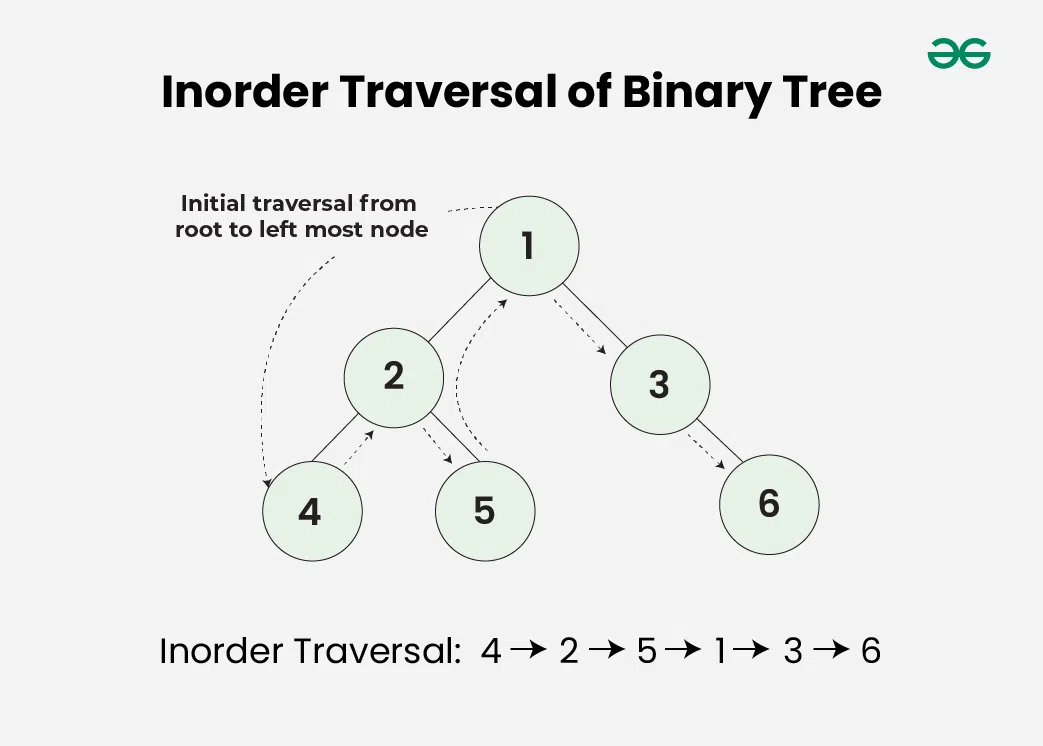
Source: GeeksforGeeks - Tree Traversals
Pre-Order
-
Visit the root node first, then the left subtree, followed by the right subtree
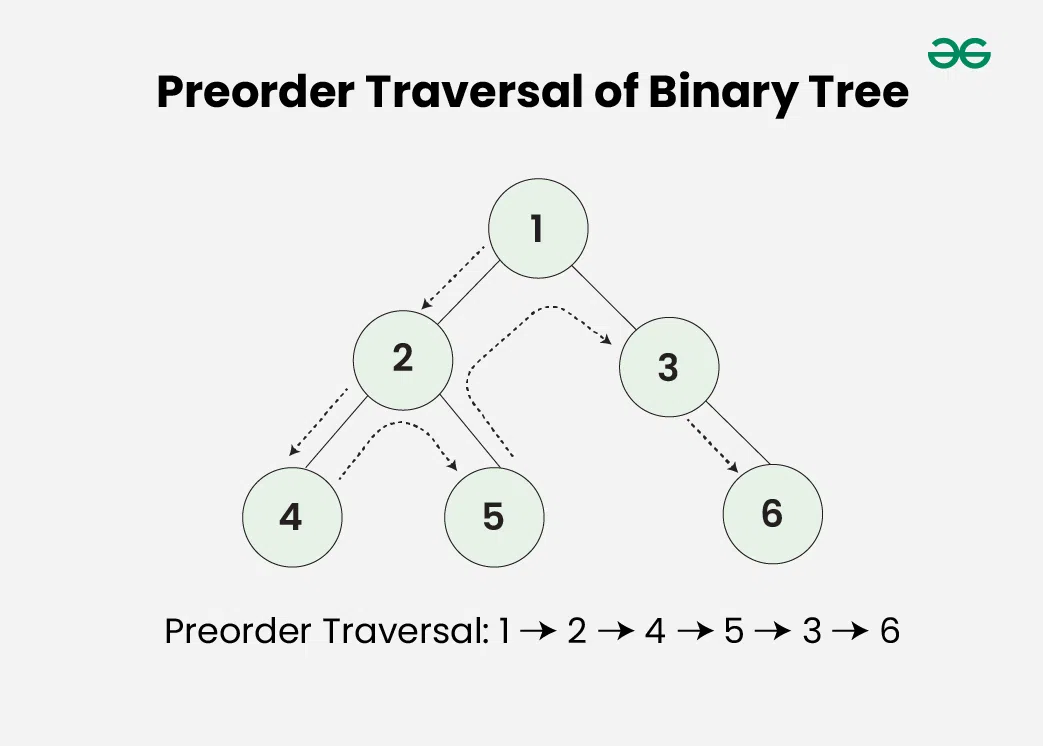
Source: GeeksforGeeks - Tree Traversals
Post-Order
-
Visit the left subtree first, then the right subtree, and finally the root node
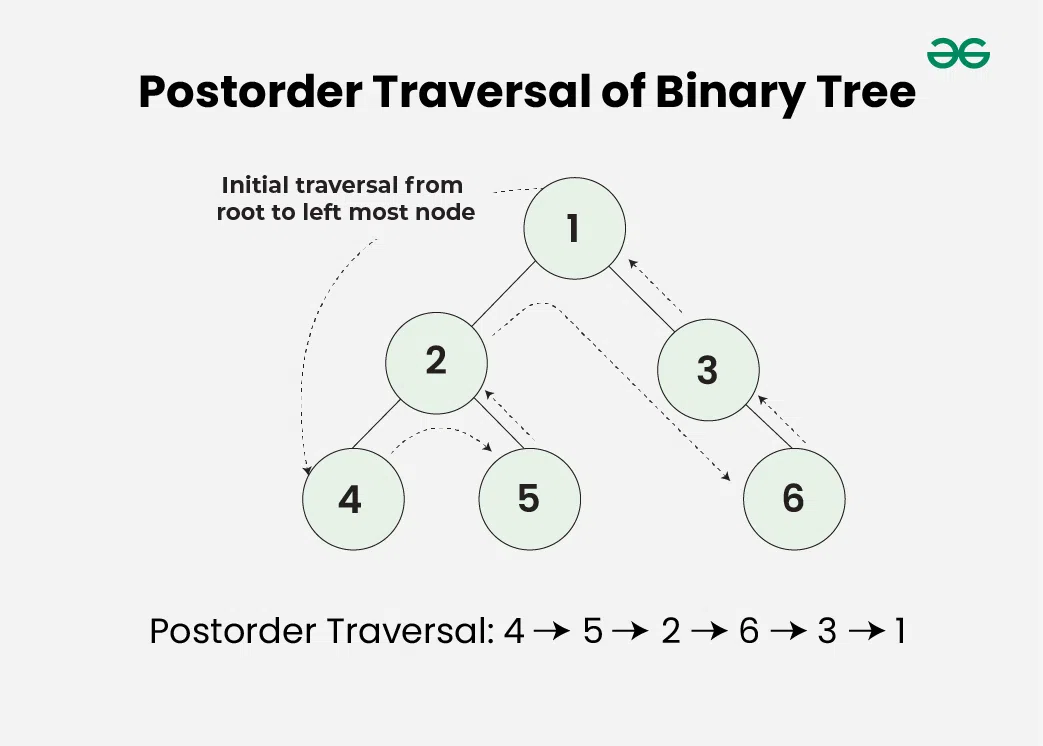
Source: GeeksforGeeks - Tree Traversals
BFS / Level Order
-
Visits all the nodes of a level before going to the next level
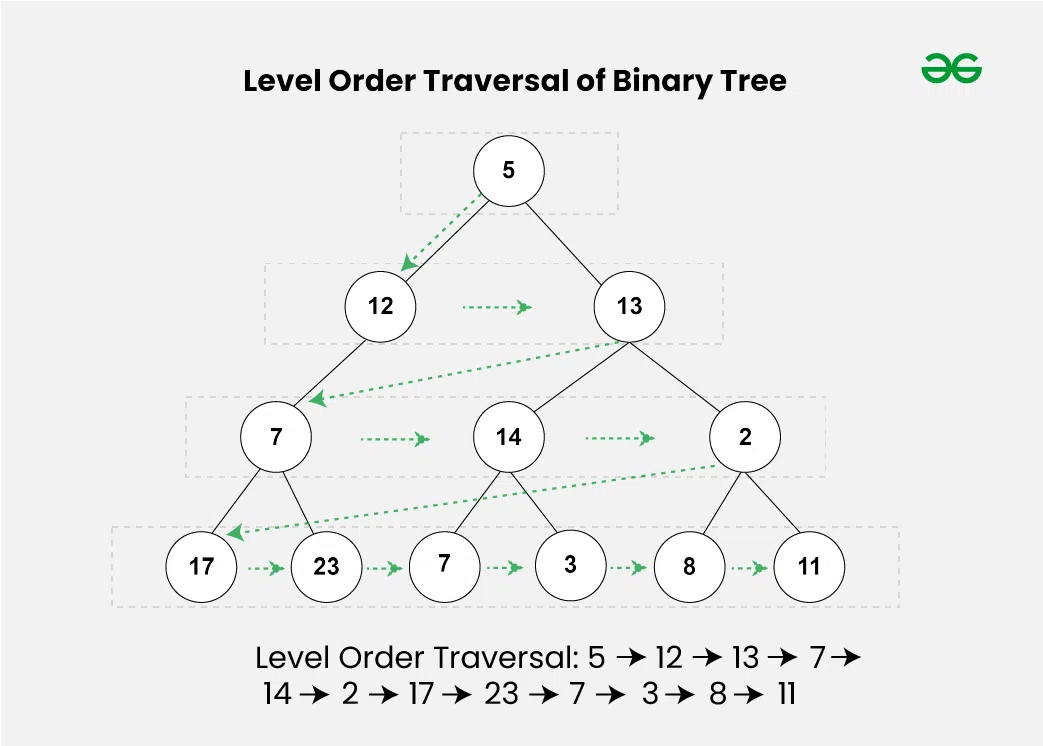
Source: GeeksforGeeks - Tree Traversals
Example Decision Tree
-
Code: https://gist.github.com/MattToegel/9e6e1d5fb97c9a3979b610f5586126b8
-
Models decision-making: Represents NPC behavior using a tree structure (
DecisionNodeclass) with yes/no branches -
Simulates conditions: Uses random checks (
Math.random()) to mimic decision outcomes dynamically -
Logs decisions: Outputs each decision and action taken during traversal for clarity and debugging
-
Handles complex scenarios: Includes decisions like healing, retreating, attacking, and finding cover
-
Encapsulates logic: Each node contains a question, action, and branches for further decisions
-
Expandable design: Easily add new decision points or branches to handle additional NPC behaviors
-
-
Compile and run (assumes folder is called
Module3)-
javac Module3/DecisionTree.java -
java Module3.DecisionTree
-
Example Scene Graph
-
Code: https://gist.github.com/MattToegel/bd81fb1ad87058abaaf99976eabf774a
-
Hierarchical object structure: Models objects like ground, trees, and clouds using parent-child relationships (
SceneNodeclass) -
Layer-based rendering: Organizes objects into layers (e.g., base, mid-level, top-level) for structured visualization
-
Individual object placement: Places objects on an ASCII canvas using their position (x, y) and symbol (G, T, etc.)
-
Composite scene creation: Combines all layers into a single view to display the complete scene
-
Rendering order: Ensures objects in higher layers appear above those in lower layers for proper visual hierarchy
-
Visual debugging: Uses ASCII art and colors to make the scene easy to understand and debug
-
Summary
-
Recursion helps with tasks like traversal and working with nested structures
-
Trees efficiently handle hierarchical data and decision-making processes
-
The utility of these concepts depends on the specific problems being solved
-
Use recursion wisely—prefer iteration when recursion is inefficient
-
Future lessons may revisit these structures